With the indestructible vajra body of noble dignity,
Helmsman guiding the beings of saṃsāra,
All the glorious supreme masters of every lineage—
I offer constant homage, never apart, never forsaking!
In the realm of peace none can compare,
By relying on him, one gains boundless merit;
The Three Jewels, source of all virtue,
Until enlightenment, I take heartfelt refuge!
The yidam who bestows the two siddhis,
The ḍākinī who accomplish enlightened activities in three places,
The dharmapālas who dispel inner and outer obstacles—
May the Three Roots grant auspiciousness always!
Now, narrating the profound chronicle of the Dharma King and master,
A concise life-story of the White Lotus
Presented to gladden the hearts of followers of the lineage,
May all who hear it attain enlightenment!
For extensive lineage of Gyaltsen Rinpoche, see here
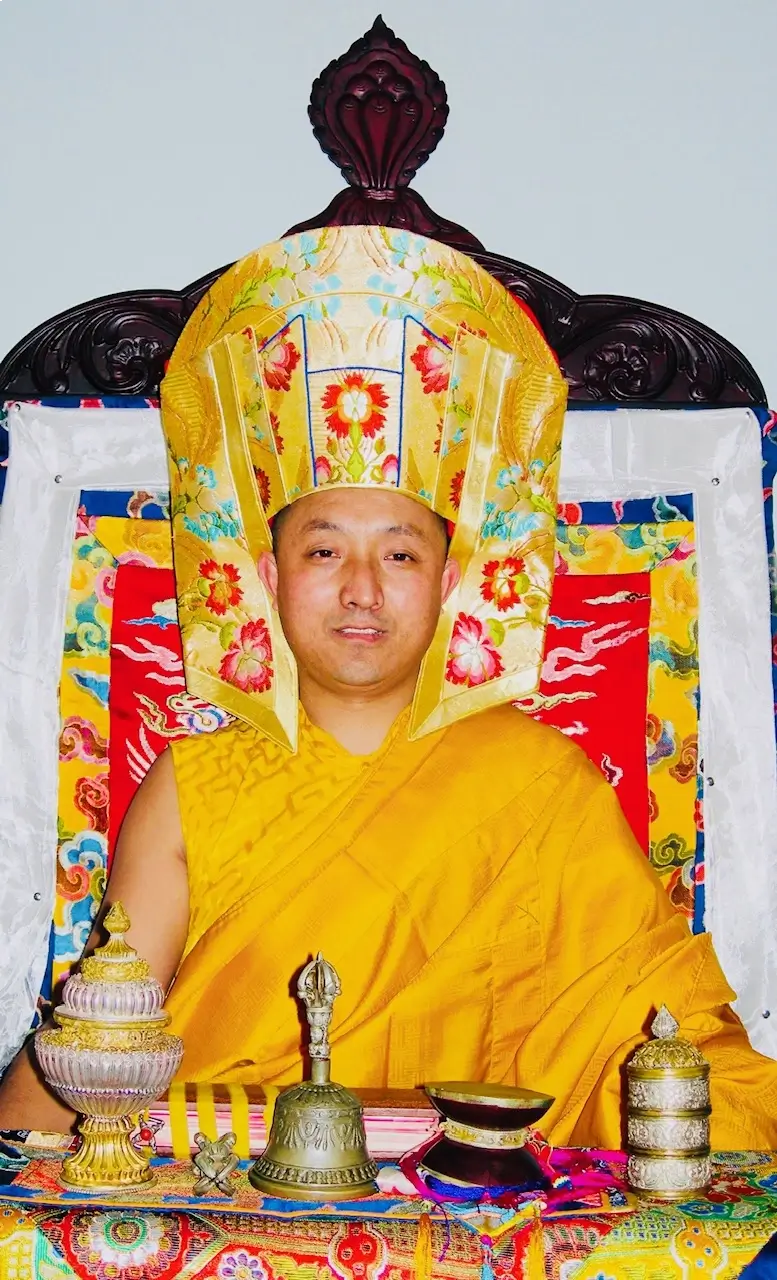
Since time without beginning, Living Buddha His Holiness (H.H.) Tulku Karma Trinley Thubten Chöje Gyaltsen Rinpoche has been undertaking countless profound endeavours to benefit all sentient beings. In each of his successive incarnations, H.H Gyaltsen Rinpoche dedicates his life for the sake of all sentient beings, shouldering the true legacy of the Tathāgata and never taking any rest.
In this lifetime, Gyaltsen Rinpoche was born on a propitious day; 6 June 1966—the auspicious day of Saga Dawa, in the Fire Monkey year of the sixteenth Rabjung Cycle according to the Tibetan Calendar. His father was a descendant of a noble divine lineage, honest and virtuous, named Ma Yongdengdeng Dorje. His mother was named Goshi Jiram; gentle and kind, approachable and sincere, who was wholeheartedly devoted to the Buddha. Gyaltsen Rinpoche was born in the glorious Chakrasamvara Palace; one of the twenty-four great sacred places equivalent to the holy site of Jajika. This sacred location is situated on the southern bank of the Dadu River—formed and nourished by countless holy sites such as Jirorzong and Guo among the twenty-four great sacred places of Dokham—in Maichu Juerwa village, Jinise Township, Nangqen County, Qinghai.
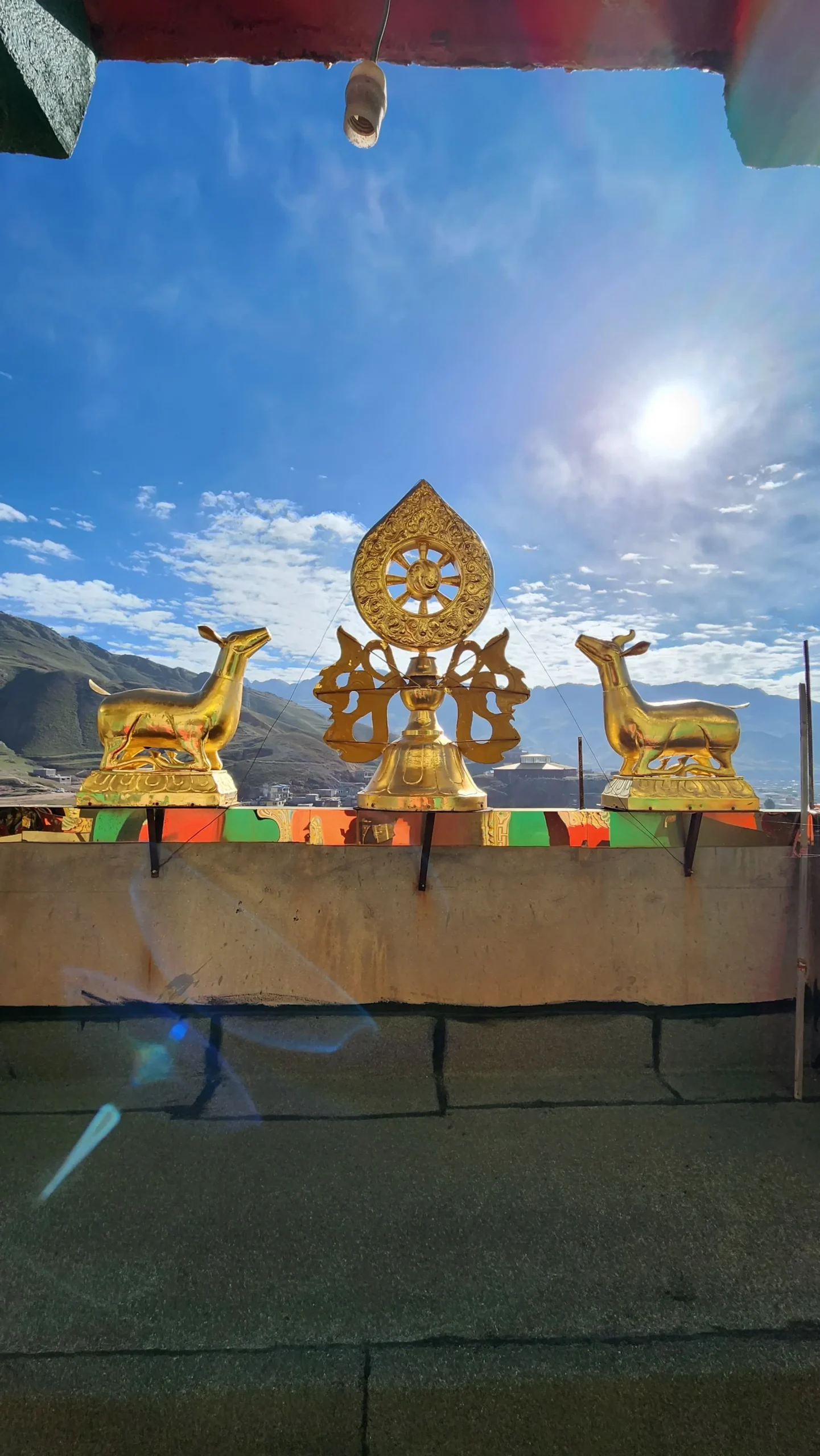
The birthplace was encircled by snow-capped mountains, and streams from the mountaintop formed several crystal-clear lakes, appearing like consecrated water offerings. Rivers and waters of the Eight Meritorious Deeds flowed sinuously, while vibrant flowers bloomed across lush meadows, creating a scene depicting celestial paradise. The geomantic qualities of Rinpoche’s birthplace were especially auspicious. Enlightened masters of earlier generations described the following areas in the snowy Tibetan land as sacred: the upper region of Ngari which consisted of three enclaves resembling lakes, the central region of Ü-Tsang which had four districts resembling water channels, and the lower region of Dokham which comprised six ridges resembling fertile fields. The birthplace of Gyaltsen Rinpoche belongs to the upper part of one of these—the Dokham Sumgang, one of the six ridges of Dokham.
Even in his childhood, Gyaltsen Rinpoche was unlike ordinary children. He naturally awakened the seed of the Mahayana, possessing from birth a compassionate heart rooted in Mahayana teachings, and often sought the welfare of all sentient beings, from insects and birds to higher beings. At the age of nine, he began studying the Tibetan script under the guidance of various teachers, and his exceptional intelligence enabled him to grasp concepts with ease. In 1978, at the age of twelve, Gyaltsen Rinpoche found refuge in the presence of H.H. Kyabje Dilyak Dabzang Rinpoche. In his presence, Gyaltsen Rinpoche was tonsured, ordained, and took refuge vows, formally entering the Buddhist path.
Even in his childhood, Gyaltsen Rinpoche was unlike ordinary children. He naturally awakened the seed of the Mahayana, possessing from birth a compassionate heart rooted in Mahayana teachings, and often sought the welfare of all sentient beings, from insects and birds to higher beings. At the age of nine, he began studying the Tibetan script under the guidance of various teachers, and his exceptional intelligence enabled him to grasp concepts with ease. In 1978, at the age of twelve, Gyaltsen Rinpoche found refuge in the presence of H.H. Kyabje Dilyak Dabzang Rinpoche. In his presence, Gyaltsen Rinpoche was tonsured, ordained, and took refuge vows, formally entering the Buddhist path.
At the age of eighteen, he undertook a retreat at La’gyab Monastery, which lasted for three years and three months. At that time, according to the monastery’s arrangement, all the retreat rooms had been assigned by lot to the monks wishing to engage in retreat practice. However, Gyaltsen Rinpoche’s father personally came before H.H Tulku Ngangchen Rinpoche, a highly venerable monk from Barom Kagyu Lineage—one of eight major Kagyu sub-schools in Tibetan Buddhism, to express his son’s wish to undertake retreat at the monastery. Upon hearing this, Ngangchen Rinpoche was extremely pleased and immediately said, “It is excellent that your child wishes to devote himself to retreat practice. He is extraordinary; we must find every possible way for him to enter the retreat center.” Thanks to this special consideration, Gyaltsen Rinpoche was granted entry into the retreat center. During this period, he diligently practiced the four common preliminary practices of worldly disenchantment as well as the five uncommon accumulation practices (Ngöndro), fully maturing his continuum. He properly engaged in the ritual practices of the main sections of the tantras, and completed the essential preliminary and advanced practices, including the six Dharmas of Nāropa, the Mahāmudrā’s “Great Perfection Path of Liberation”, and the essence of the 84,000 dharma doors, ultimately becoming a heart disciple of Ngangchen Rinpoche.
While residing in the meditation retreat, he frequently showed concern for the monks practicing the Dharma and generously offered large amounts of wealth. He also made countless offerings of lamps to the Buddhas and Bodhisattvas, diligently accumulating merit and spiritual wealth. Before the seat of Ngangchen Rinpoche, he received teachings on both the new and old lineages, along with their empowerment, transmissions, and esoteric instructions. Combining his remarkable devotion and intelligence, Gyaltsen Rinpoche became one of the supreme heart disciples of Ngangchen Rinpoche. Upon completing his practices, he was specially instructed by the venerable master to go to Juela Monastery, situated along the upper stretches of the Mekong River, to study the Dharma. There, under the guidance of H.H Khenpo Shyedrub Dzormig, he studied Tibetan grammar and vocabulary, Gampopa’s “The Sublime Liberation Treatise”, the teachings of Guru Samantabhadra, Tsongkhapa’s “The Jeweled Garland of the Path to Enlightenment”, as well as Avalokitesvara’s sutra among other supreme teachings. Over a further period of three years, Gyaltsen Rinpoche achieved remarkable success in his studies.
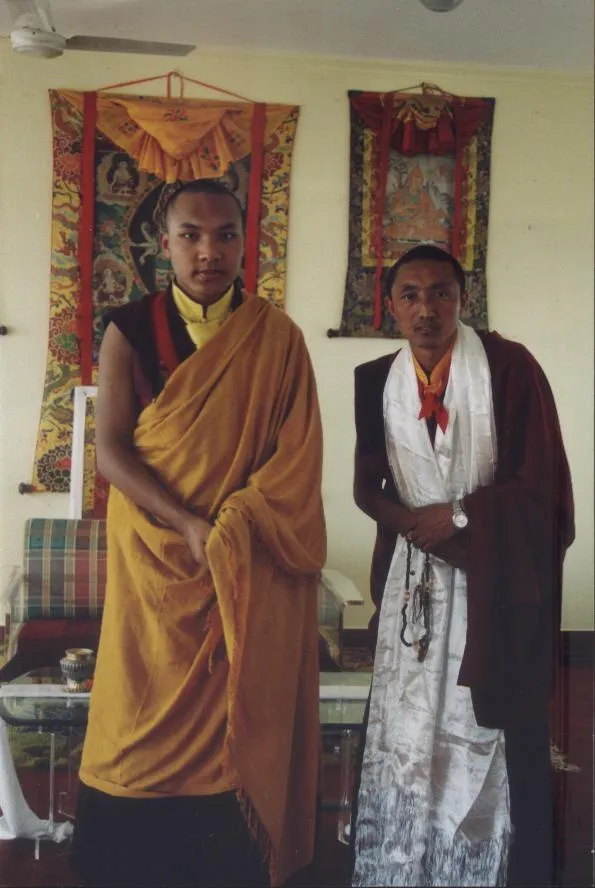
Later, when the sixteenth Karmapa, the Great Dharma King, was reborn as the seventeenth Karmapa, H.H. Urgyen Trinley Dorje, a grand enthronement ceremony was held at Tsurphu Monastery. During this time, Gyaltsen Rinpoche went to Tsurphu Monastery to study under the retreat master H.H Drupön Dechen Rinpoche, receiving teachings, empowerments, transmissions, and esoteric instructions. Afterwards, Gyaltsen Rinpoche traveled to India, the sacred land of Shakyamuni Buddha, and studied under H.H Tai Situ Rinpoche and H.H Gyaltsab Rinpoche, learning essential teachings such as “Entering the Bodhisattva’s Way”, “The Introduction to the Wise”, and Mahāmudrā extensively. He also relied upon many accomplished Kagyu masters, including H.H Sangye Nyenpa Rinpoche, to study extensively the threefold essence of empowerments, instructions, and transmissions, dispelling both internal and external doubts.
Gyaltsen Rinpoche’s study and contemplation of Dharma did not remain at the level of mere hearing; he emphasized both hearing and contemplation in practice, diligently applying himself to meditation, through which he attained various realizations and accomplishments:
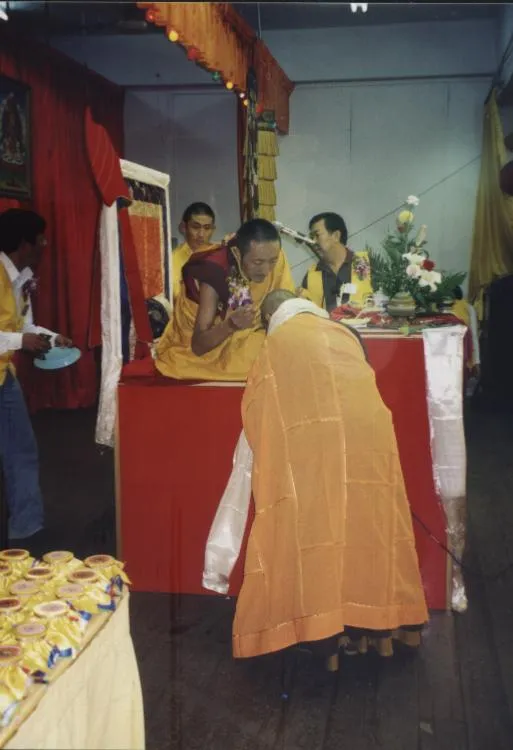
Throughout his lifetime, Gyaltsen Rinpoche had been diligently studying and practicing Buddhism under many accomplished masters in India, Nepal, and Tibet, becoming a veritable treasury of empowerment transmissions. Furthermore, during the seven years that Gyaltsen Rinpoche resided at Rumtek Monastery Karma Shri Nalanda Institute—founded by the sixteenth Karmapa H.H Rangjung Rigpe Dorje in Sikkim, India—he served as the head chant master, making numerous contributions to the local Buddhist community.
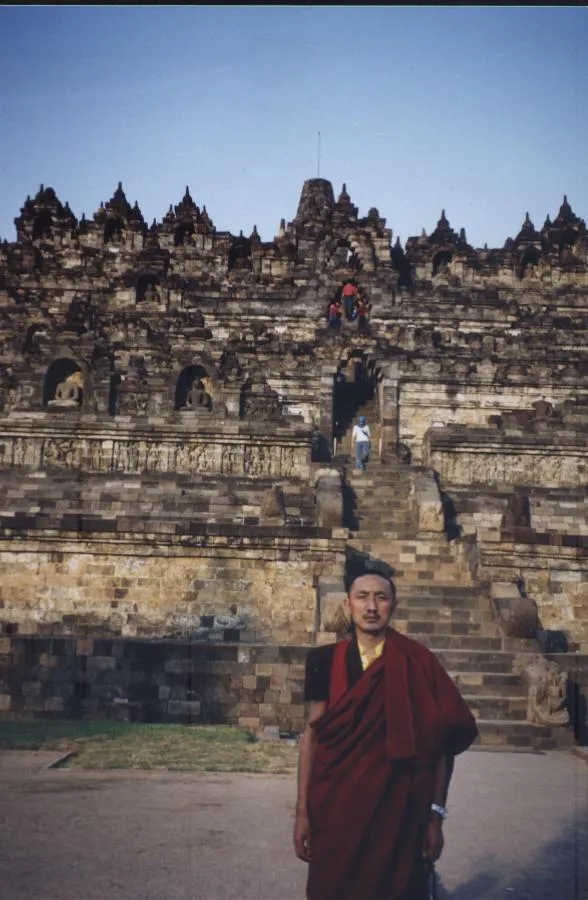
The Venerable Gyaltsen Rinpoche sought to promote Dharma and benefit sentient beings by carrying out propagation work and establishing monasteries in regions where the teachings were difficult to hear. Driven by this aspiration, he fearlessly traveled to Singapore, Malaysia, Indonesia, and other countries to give teachings and spread the sound of the Dharma. Wherever he went, he generously offered wealth to beggars, liberated countless sentient beings from slaughter, and fearlessly committed to works of charity.
Subsequently, he returned to Tibet inspired by the desire to support the monastery in his hometown where his ancestors dedicated themselves for generations—the sacred Tana Monastery, which he now resided at. Upon his return, he received the encouragement and support of H.H Apan Rinpoche and gladly accepted the responsibility of supporting his native monastery. Undaunted by difficulties, he traveled throughout the Ngari region in Tibet and abroad, personally returning with donations from devotees for the purpose of supporting Tana Monastery and its community of monks. In particular, he contributed several hundred thousand Chinese RMB toward the construction of the Tana Monastery Lecture Hall. His efforts to further the monastery’s development and care for the monks were not intended to gain personal fame, but solely for the welfare of all sentient beings.
Through the dedicated efforts of Gyaltsen Rinpoche, Dhonggar Palri Monastery was built in Nangqên, Tibet, on the site of the formerly destroyed monastery, accompanied by a spacious dormitory to accommodate monks studying and practicing Buddhism. Today, Dhonggar Palri Monastery stands as the foundational pillar supporting the charitable organisation founded by Gyaltsen Rinpoche overseas, namely Dhonggar Palri Six Pāramitā Foundation in Jambi (Indonesia), to further promote acts of compassion and benefits for sentient beings.
In summary, the Living Buddha His Holiness Tulku Karma Trinley Thubten Chökyi Gyaltsen Rinpoche is like a white lotus arising unstained from the mire, despite abiding in saṃsāra. He faithfully follows and relies upon the Buddha’s teachings, tirelessly enduring hardships to travel abroad and give teachings for the benefit of sentient beings. The wealth offered by devotees is never squandered; it is wholly dedicated to supporting Dhonggar Palri Monastery and other endeavors that promote the welfare of all beings.
For the Dharma and all sentient beings,
He deliberately takes rebirth in the world of samsara.
Merits manifest as vast as the sky;
Here, they are described only in brief outline.
With pure, undefiled intention as the near cause,
He treads upon the ground where lineage sages walked;
To widely expand the supreme virtuous deeds of the Dharma,
The work of the forebears is entrusted to the wise.
The virtuous fruits born of diligent practice,
Accomplish the long life of the noble guru;
May the auspicious deeds that benefit all beings,
Shine forth like rays across all realms!